

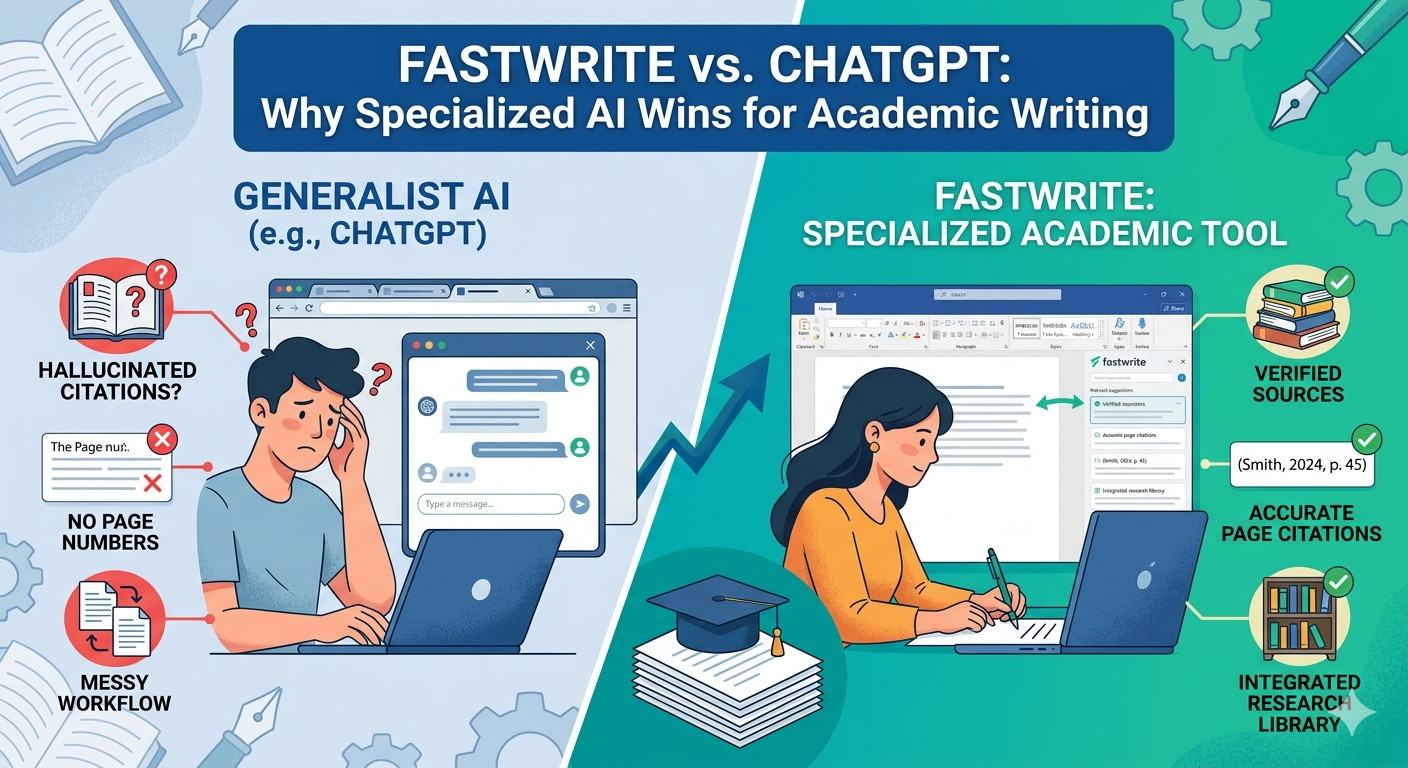
In 2026, ChatGPT is the first reflex for many students when an essay stalls. Quickly draft a paragraph, generate an outline, paraphrase a definition – OpenAI's tool is universal, free at the entry level, and a tab away. Surveys consistently show that over 80 percent of students now use generative AI tools at least occasionally for academic work, and ChatGPT is by far the most common.
That convenience is also what makes ChatGPT risky for academic writing. A generalist does not know your sources. It does not know whether the book it cites actually exists. It cannot work inside your Word document. And it cannot give you feedback against the criteria your professor will actually use to grade you.
This article compares ChatGPT and fastwrite honestly – including the places where ChatGPT is the better tool. The goal is not to talk one tool down, but to show you where each tool belongs and why a specialized writing assistant is almost always the better fit for essays, term papers, theses, and dissertations.
What ChatGPT Does Well
Before the criticism, a fair stocktake. ChatGPT is an exceptionally capable general-purpose language model. For many study-adjacent tasks, it delivers usable output quickly:
Brainstorming and topic exploration. When you don't yet know what to write about, ChatGPT is a useful sparring partner. You can generate topic ideas, structure pro-and-con arguments, or sharpen a research question.
Sentence-level rewriting. When a sentence sounds clunky, ChatGPT can offer several alternatives. Reformulating a tangled paragraph into clearer prose is something it handles well.
Explaining abstract concepts. When you don't understand a theory, ChatGPT can explain it in plain language. This doesn't replace reading the original source, but it helps you get started.
Translation. Moving between your first language and academic English – or summarizing foreign-language sources – works smoothly, especially with the current model generation.
Emails, templates, casual writing. For anything that doesn't need to be scientifically grounded, ChatGPT is fast and good enough.
Using ChatGPT for these tasks and checking the output yourself is fine. The trouble starts as soon as academic standards enter the picture.
The Structural Weaknesses of ChatGPT for Academic Writing
ChatGPT was not built for writing research papers. It is a general-purpose language model trained on enormous amounts of text. That architecture creates five concrete problems for anyone writing academically.
1. Hallucinated sources
The single biggest risk. ChatGPT generates text that looks like a citation without actually retrieving anything from a source. Multiple studies have documented that up to 40 percent of references suggested by general-purpose LLMs do not exist – so-called hallucinations. The titles sound plausible, the authors are real, the journals exist, but the specific article is fabricated.
For your paper, this is not just embarrassing – it is dangerous. If your examiner spot-checks your references (which is increasingly standard practice), and discovers that the cited study does not exist, that is a clear violation of academic integrity. The consequences range from a failed paper to formal misconduct proceedings.
2. No real page references
Even when ChatGPT happens to name a real source, it cannot reliably tell you the page number. The model has no access to the physical pagination of a book or PDF. Examiners regularly find "physically impossible" page numbers in student work – page references beyond the actual length of the source, or attached to content that appears on a completely different page. For any direct quotation under APA, MLA, Chicago, or Harvard, the exact page is mandatory.
3. No access to your own sources
ChatGPT can read PDFs you upload, but it treats them as single-session context. The moment the conversation gets long or you start a new session, the knowledge is gone. You cannot maintain a persistent library, cannot search across multiple PDFs reliably, and you do not get verifiable passage references with page numbers, because the model does not preserve document structure.
But that is exactly what academic work requires: working with your sources, your notes, your annotations, over weeks.
4. Browser instead of word processor
ChatGPT lives in a browser tab. You write your paper in Microsoft Word. That means constant context-switching: select a paragraph, paste into the browser, write a prompt, copy the answer back, return to Word, paste, reformat. Over a 15-page paper, those switches add up to hours.
The citation manager, the styles, the comments from your supervisor, the auto-generated reference list – all of that lives in Word. Writing in one tool and thinking in another breaks the flow.
5. No academic feedback
Ask ChatGPT whether your introduction is good and you get generic, friendly feedback. ChatGPT does not know your department's grading criteria, does not know what counts as a "clear research question" in your field, and cannot judge whether your methodology meets the standards of empirical research in your discipline. The feedback is pleasant but not actionable.
What fastwrite Does Differently
fastwrite was built specifically for academic writing. That choice shows up in the architecture – and that is exactly where the differences from ChatGPT live.
In Word, not in a browser
fastwrite is a Microsoft Word add-in. You work inside the application you already write in, with your styles, your footnotes, your supervisor's comments. Suggestions appear next to your cursor. No tab-switching, no copying, no pasting. If you write in Word, you stay in Word.
Real sources instead of hallucinations
The fastwrite model does not invent sentences out of thin air. It runs on a RAG pipeline (retrieval-augmented generation) that draws on the literature you upload and on a database of millions of academic sources. Every suggestion that includes a citation is linked to the actual source and the actual page number – verifiable, clickable, correctly formatted.
That is the structural difference: ChatGPT generates plausible-sounding text. fastwrite generates text that is backed by a real source.
With fastwrite Chat: your tutor for your paper
Since May 2026, fastwrite has a new mode that closes the gap to ChatGPT entirely: fastwrite Chat. It is an AI tutor designed specifically for academic writing, and it does five things ChatGPT cannot do in this form.
First, discuss your document. You ask questions about your own text and get direct feedback – not on some example, but on the exact Word document you are working in right now.
Second, search your own sources. You upload your PDFs to your fastwrite library, and the chat finds the relevant passages on demand – including the page where the passage sits. This is the central function ChatGPT cannot match.
Third, find papers from the fastwrite database. When you still need literature, the chat searches a database of millions of academic articles and suggests relevant hits. The sources actually exist – every match is verified.
Fourth, discuss a specific PDF. You select one PDF from your library and ask questions about it: "How does this author define X?" or "What method does Chapter 3 use?" The answer comes with a page reference.
Fifth, Deep Review. Your paper is evaluated against nine criteria drawn from real university grading rubrics – from clarity of the research question to argumentative structure. You get concrete improvement suggestions and clear next steps. That is feedback at academic level, not a generic "well done".
Comparison at a Glance
Source access
ChatGPT: none, hallucinates sources frequently
fastwrite: real sources from your library and the database, all verifiable
Page references
ChatGPT: unreliable, often fabricated
fastwrite: extracted directly from the PDF
Integration
ChatGPT: browser, external tab
fastwrite: directly inside Microsoft Word as an add-in
Personal library
ChatGPT: no persistent access, context lost between sessions
fastwrite: persistent library, the chat knows every document you have uploaded
Academic feedback
ChatGPT: generic
fastwrite: Deep Review against nine university grading criteria
Focus
ChatGPT: general-purpose chatbot, all topics, all use cases
fastwrite: built for academic writing, from sources to citations
Pricing
ChatGPT: Free / Plus from USD 20 per month
fastwrite: Free / Premium from EUR 18 per month (annual plan)
A Realistic Workflow Using Both Tools
You do not need to ban ChatGPT entirely to write a strong paper. The sensible approach is a division of labour where each tool does what it was built for.
In the topic-finding phase, ChatGPT is useful as a brainstorming partner. Collect questions, structure arguments, clarify concepts. Important: anything that looks like a source needs to be independently verified in Google Scholar, JSTOR, or your library catalogue afterwards.
In the research phase, switch to fastwrite and its database. Upload your sources to the library, let the chat surface the passages you need, and collect verifiable citations.
In the writing phase, work in Word with the fastwrite add-in. You write the text yourself, accept autocompletes where useful, insert evidence-backed passages with correct page references, and manage citations directly inside the document.
In the revision phase, use Deep Review to find structural weaknesses, and work through the improvement suggestions one by one. ChatGPT can still help with sentence-level rewording here, but it should not generate substantive content at this stage.
What the Law Is Starting to Say
For anyone using ChatGPT for academic work, the legal landscape matters more than it did even a year ago.
The most cited case so far is the University of Minnesota. In 2024, a third-year PhD student, Haishan Yang, was expelled after faculty compared his remote qualifying exam answers to ChatGPT output and found similarities. The expulsion cost him his doctoral program, his student visa, and his legal status in the United States. Yang sued, claiming due-process violations. Both a federal district court and the Minnesota Court of Appeals upheld the expulsion, finding the university's decision reasoned and evidence-based. The case is now precedent: where institutions build a clean record and follow process, courts back academic-integrity rulings.
The UK has seen similar enforcement. According to data obtained by The Guardian via Freedom of Information requests, nearly 7,000 proven cases of AI-assisted cheating were recorded in UK universities in 2023-24, up from 1.6 per 1,000 students the year before to 5.1 per 1,000. Times Higher Education reported that individual institutions like Sheffield, Queen Mary, and Glasgow saw their AI misconduct cases jump from single digits to nearly a hundred each in a single year. Experts consistently say these numbers are the tip of the iceberg.
The core message of all this enforcement: it is not AI use as such that gets punished. It is undisclosed AI use – passing off generated text as your own original work. Students who use AI transparently as a permitted aid, with verifiable sources and proper disclosure, are working within the rules. Students who paste in hallucinated citations or hand in entire AI-generated passages risk their degree.
fastwrite is built precisely for the permitted use case: as an aid with verifiable sources that supports your own work, but does not replace it. ChatGPT is not – not because it is a bad tool, but because it was not designed for this purpose.
When ChatGPT Is Still the Better Choice
Just so this is not one-sided: there are situations where ChatGPT is clearly the better fit.
If you are writing non-academic text – cover letters, emails, notes, social media posts – ChatGPT is more convenient because it does not need scholarly accuracy.
If you are solving complex coding problems, ChatGPT with its code interpreter is a strong tool that fastwrite does not replace.
If you are writing creative work outside your studies – short stories, fictional dialogue, song lyrics – ChatGPT has the broader range.
One thing to be clear about: brainstorming, outlining, sparring conversations about your topic, or writing in a non-English first language are not ChatGPT-exclusive use cases. fastwrite Chat handles all of these just as well – with the added advantage that it already knows your sources and your document.
But the moment your work is going to be graded, has to answer a research question, or has to cite a source, you need a tool that was built for that purpose.
Conclusion
ChatGPT is an impressive generalist. For an essay, a term paper, a thesis, or a dissertation, it is the wrong tool. Hallucinated sources, missing page references, no access to your own literature, no Word, no academic feedback – every one of those weaknesses is a risk to your grade and, in the worst case, to your degree.
fastwrite solves exactly those problems: real sources instead of hallucinations, exact page references, a persistent library backed by a RAG pipeline, Word integration, and with fastwrite Chat an AI tutor that knows your documents, finds you sources, and reviews your work against nine university grading criteria.
Use both, and you get the best of each: ChatGPT for the non-critical tasks where speed matters more than rigor, fastwrite for the actual academic work. Rely on ChatGPT alone for your paper, and you are betting that your examiner will not check the references and that the model will not hallucinate. That is a bet you do not need to make.
fastwrite has a free tier. Anyone curious about what academic writing with real sources feels like can try the tool in five minutes – without leaving Word.



.svg)


.svg)

.svg)
.svg)